
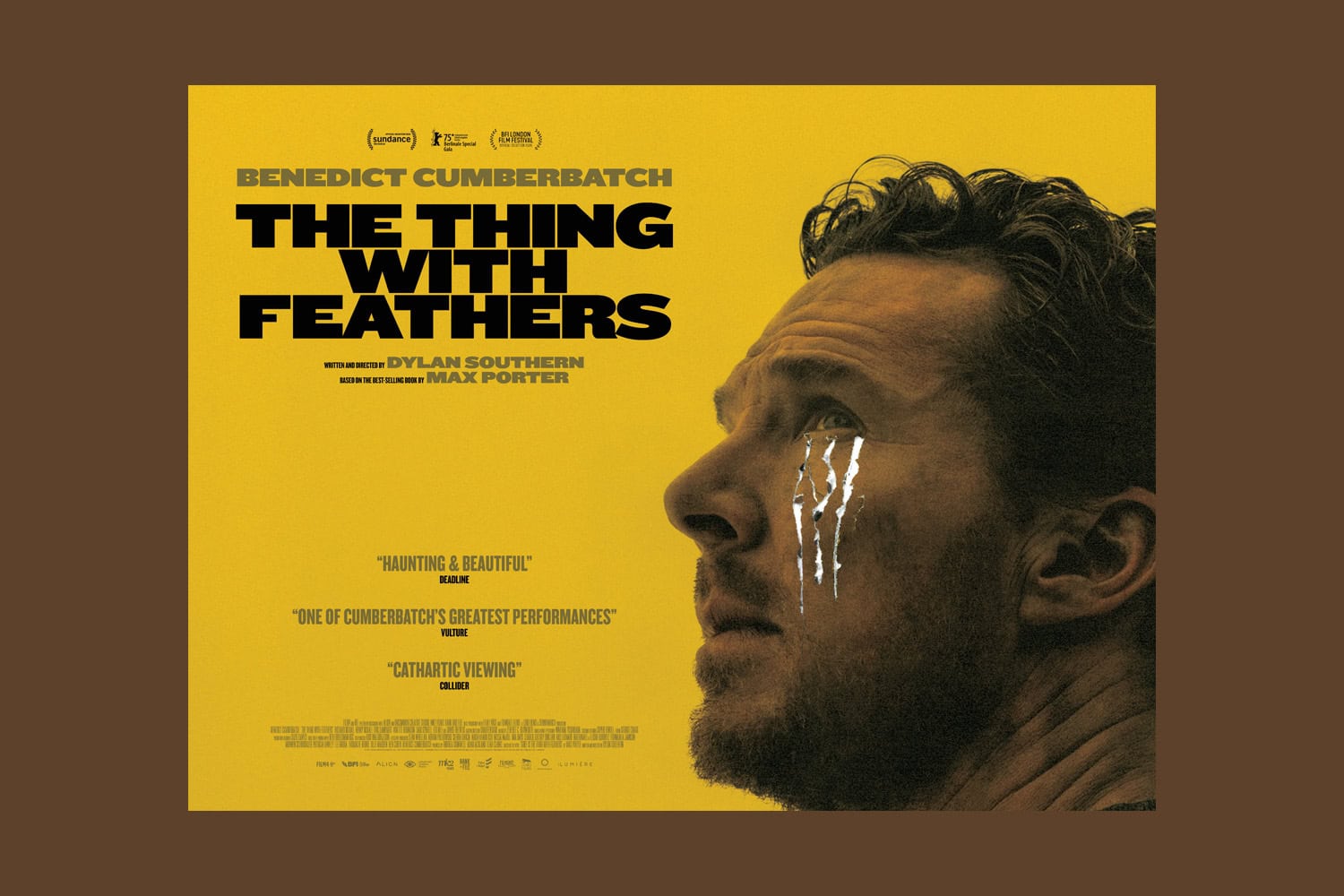
Free Tickets to The Thing With Feathers were extended to New Orleans Film Society Members. To get exclusive access to free screenings and members only events purchase your membership here.
*Spoiler Alert*
By any conventional description, The Thing with Feathers is a grief-horror film. It stars Benedict Cumberbatch as a widowed father whose life, and the lives of his two young sons, are invaded by an enormous, foul-mouthed crow in the weeks after the sudden death of his wife. The premise reads like something between folklore and fever dream: grief manifesting as a creature that bullies, banters, smashes, and looms in dark hallways. And because the film has been marketed and received as horror, it has baffled audiences who went in expecting terror, jump scares, and genre satisfaction. They didn’t get that. If you sit down anticipating a horror movie, you will be let down — no doubt — and this mismatch of expectation, and inexplicable marketing plan, is almost certainly responsible for the film’s polarized reviews.
But the error is not in the film; it is in the framing. The Thing with Feathers is not a horror story. It is a psychological healing narrative disguised as one, a work far closer to Joseph Campbell’s inward-facing hero’s journey than to any monster movie. Once you shift the lens — once you understand the film as a myth about descending into oneself to emerge changed — it becomes something profoundly moving.
In Dylan Southern’s quietly astonishing adaptation of Max Porter’s Grief Is the Thing with Feathers, the giant crow is not the villain. He is a therapist — volatile, abrasive, occasionally cruel — but a therapist all the same. And his technique of choice is art therapy. The film’s central revelation is not that the supernatural walks among us, but that healing requires creation: movement, drawing, collage, and the willingness to make something messy and unguarded in the presence of another.
The story, like Porter’s novella, begins in the quiet, exhausted terror that follows loss. The father is paralyzed by mourning, the children suspended in an eerie emotional limbo. Crow’s arrival shatters that immobility. He barges in like an unwelcome houseguest, pulling bodies and emotions into motion. His presence is chaotic, vexing, and sometimes vicious — but always purposeful. Porter has been explicit that the emotional core of the book draws on his own childhood: “The experience of the boys in the flat is… based on my dad dying. When I was… six.” He has also said that writing the book became “an opportunity for me to work out how I felt, about my brother, and about my dad.” Rather than presenting grief as tidy or polite, Porter describes it as “bespoke, as individual as a fingerprint,” and he invites readers to “rethink mourning’s generative possibilities…” Southern extends that exploration into the visual realm, and what emerges is not conventional therapy but something closer to ritual: messy, embodied, and profoundly creative — a framework that the film deepens through its engagement with multiple forms of art-based healing.
That ritual begins, fittingly, with drawing — the father’s home territory. Before Crow drags him into any new or frightening forms of expression, he meets the father where he already lives: at the page. Cumberbatch’s character, a graphic novelist, sits down to sketch a clean, sentimental image of his children, the sort of controlled pastoral scene he might once have drawn without thinking. It is neat, composed, emotionally inert — an attempt not to express grief, but to avoid it.
Crow recognizes this instantly. He mocks the drawing, insults its precision, and demands something less polite and more honest. What follows is an eruption. The father abandons his tools, smears ink with his hands, destroys the tidy lines he’d hoped would contain his feelings. The page becomes a battlefield, the ink a raw material for everything he’s been refusing to feel. Only through vandalizing his own work does he finally break open. It makes psychological sense that drawing comes first: it is the language he already speaks, and Crow uses that familiarity to push him into unfamiliar emotional terrain.
But the art therapy does not stop there. Later in the film, Crow expands the modality entirely. The father, deep in his paralysis, lies drunkenly on the couch, half-submerged in the stillness of early grief, mourning through music that only keeps him numb. This time, Crow does not hand him a pencil; he forces him to stand. The bird shoves him across the room, prodding him into motion he does not want and has never practiced. What begins as aggression becomes choreography. Crow flips the music from dirge to pulse, and suddenly the father is dancing — badly, awkwardly, on the edge of collapse, as Crow puts it “primally” — but dancing nonetheless.
The scene is, on the surface, strange and a little absurd: a grown man pushed into movement by a mythic creature, stumbling into motion he did not choose. But anyone familiar with somatic therapy will recognize precisely what is happening. When language fails, the body often speaks first. The father breaks not because he articulates a feeling, but because the movement awakens it. He laughs, sobs, gasps — not neatly, not beautifully, but truthfully. Crow’s intervention resembles the work of a practitioner coaxing a shut-down nervous system back online, back into expression, pushing the father into a form of embodiment he has long avoided.
This shift from drawing to dance is the film’s most striking depiction of therapeutic growth. The father is no longer expressing grief through the medium he knows; he is being asked to inhabit an entirely new form, one that demands he feel through his entire body rather than just his hands. Movement becomes revelation. The expressive modalities widen — first art, then artistic embodiment — each pushing him further from avoidance and closer to truth.
The most delicate sequence of guided art therapy belongs to the children. When Crow declares it is time for them to face their mother’s death, the father pleads for gentleness, and Crow obliges. Instead of terror, he gives them an assignment: “Make her.” In a beautiful depiction of child-centered bereavement therapy, the young boys receive torn paper, string, tape, scraps — a kid’s version of a sculptural studio — and begin constructing an effigy of their mother. One child attempts meticulous realism, clinging to a photograph as if precision might resurrect presence. Crow presses him, gently but firmly, to look deeper. He wants essence, not likeness.
The collage becomes a vessel for feelings too large to articulate. The children pour memory, longing, and love into the object they are creating. And when Crow’s promise — that the most honest depiction will come alive for one day — is revealed to be a lie, their fury erupts. The fantasy of resurrection dies, and in its place appears something more honest: grief that finally has permission to be felt.
What makes The Thing with Feathers so quietly radical is not that it catalogs a series of artistic exercises. It is that it frames art-making as the best available language for a family whose world has ruptured. The children do not talk their way through loss; they build it. The father does not rationalize his pain; he dances it, smashes it, inks it into being. Crow is less a supernatural creature than a midwife, dragging unbearable feelings into form.
This becomes clearest in the film’s final movement. After two years of chaos, ritual, art making and reluctant growth, the father gathers his drawings — the slopped ink, the wrecked pages, the sketches born of nights of rupture — and turns them into a bound graphic novel. It does not erase sadness. But it integrates it. If the earlier scenes are the therapeutic process, this final creation is the therapeutic product: a container strong enough to hold what he could not bear alone. The therapist’s work is complete. Crow disappears. What remains is art and healing.
We live in a culture that often tries to domesticate grief, to nudge it toward politeness, to treat mourning as a private matter best managed quietly and efficiently. The Thing with Feathers rejects that entirely. It insists that grief is unruly, embodied, and deeply creative, and that healing happens not through stoicism or rationality, but through making — through the willingness to dance badly, draw messily, build something fragile with your own hands and even destroy it.
Reframed this way — not as horror, but as myth, ritual, and therapeutic journey — The Thing with Feathers becomes more than a divisive genre experiment. It becomes a reminder that the oldest stories were always about transformation, and that the bravest thing we can do with grief is not to fear it, but to give it shape.
Crow may be fantastical, but his methods are not. To move is to feel. To draw is to confront. To make is to mourn. And to turn pain into creation — a dance, an ink smear, a collage, a book — is one of the few ways we have to stay alive with the people we have lost.