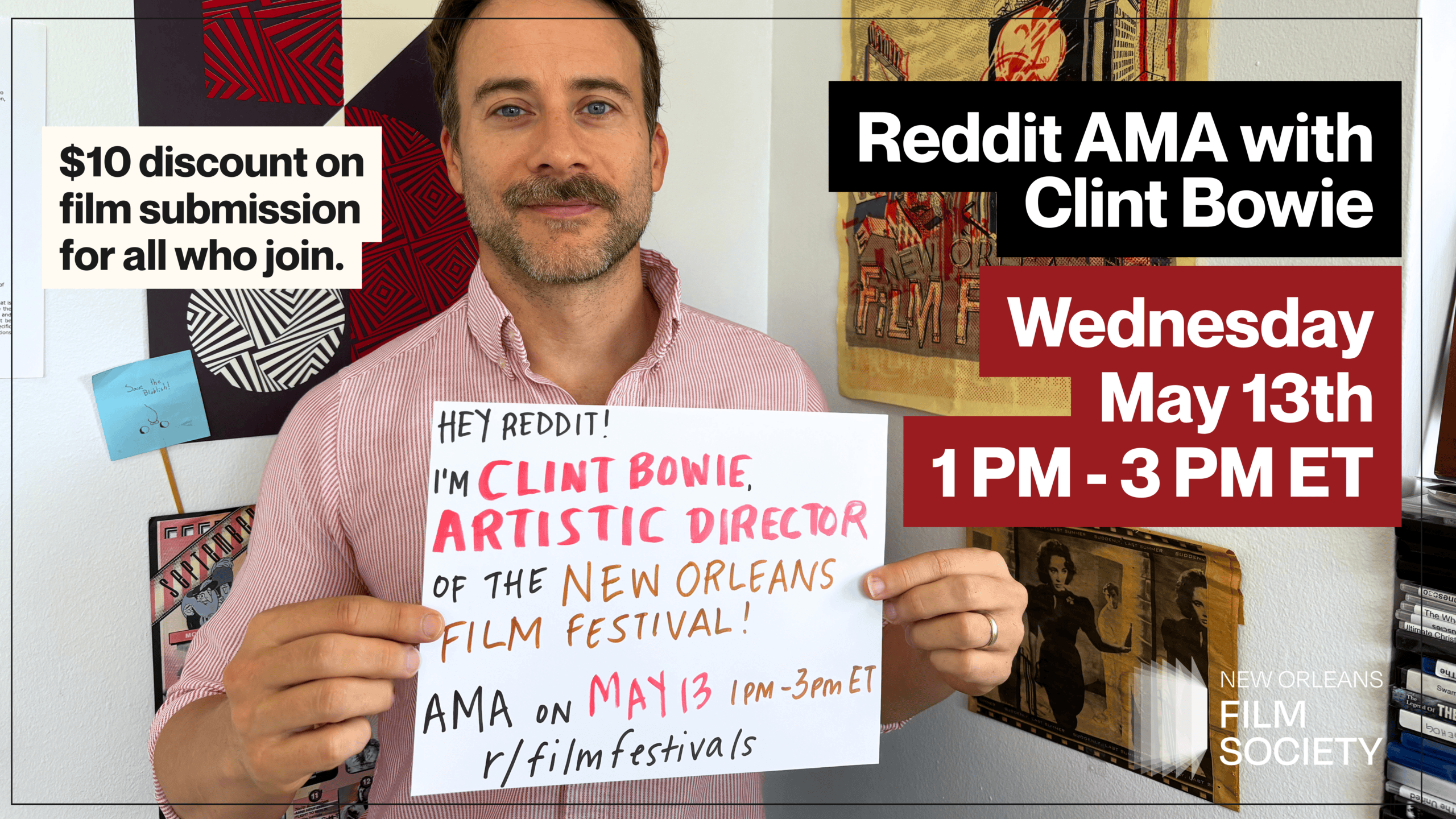
Hi, I’m Clint Bowie, Artistic Director of the New Orleans Film Society. On Wednesday, May 13, I held a Reddit AMA (Ask Me Anything) to answer filmmaker questions about best practices when submitting work, how films are reviewed for the New Orleans Film Festival, and how important it is to “know someone” at the festival you are submitting to.
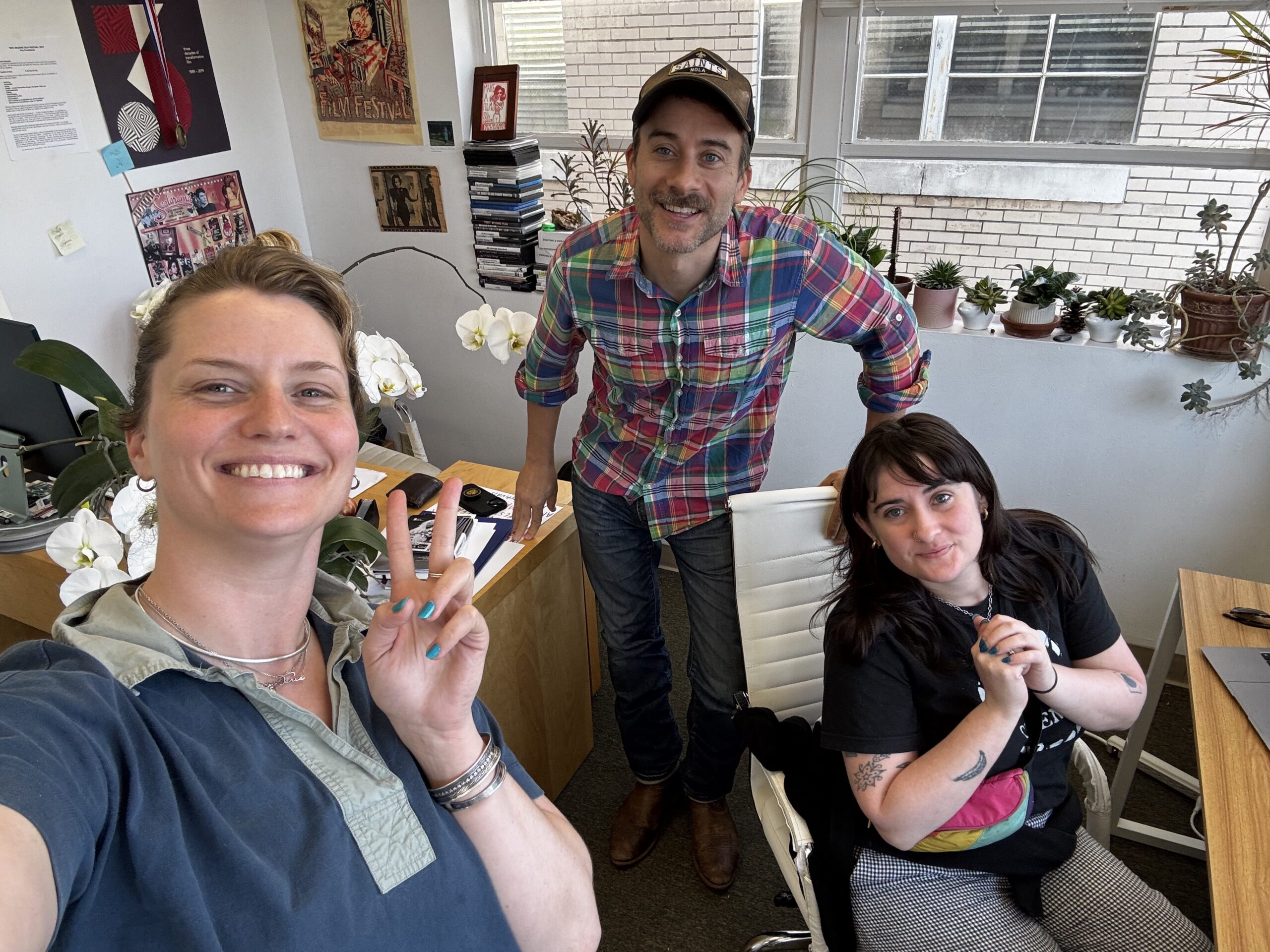
It was a very lively discussion with over 150 comments and 10K views! I was so impressed with the thoughtfulness of the questions and the level of engagement and want to say thank you to everyone who participated. I had a lot of fun with Torie Nugent-Peterson NOFS’ Development Manager and Steffi Tell, a longtime member of the NOFS Programming and Marketing team who were helping me think through answers.
I’d also like to invite any filmmakers to submit their work before our final deadline on May 29 with a $10 discount code noffREDDIT10
 I’ve selected a few questions from the AMA to share with you below. To see the full AMA on Reddit, please click the button at the bottom of this page. You don’t need a Reddit account to view the AMA.
Thanks again and enjoy looking through the Q&A below.
Select Questions from Clint’s AMA
Q: I submitted my short film so fingers crossed! Would love to know what stood out about past submissions that helped them get in? Are there any mistakes you see new filmmakers make that hurt their chances?
Clint: Thanks for sharing your short with us!!
In terms of what has stood out in past submissions, our team is always drawn to something different. When you’re watching literally hundreds of films, they can start to run together, so we’re looking for films with a strong point of view and films that take risks. We’re also looking for filmmaker potential, which can be tricky to describe, but a question we ask ourselves frequently is, “Do we want to see what this filmmaker does next?” Make us say yes.
Regarding “mistakes” from early career filmmakers, here are 5 pieces of advice I’d offer:
- Avoid too much exposition. Allow viewers to connect the dots themselves.
- Pare your film down to its essentials. Focus on what’s critical to the story you’re trying to tell and cut, cut, cut. It will be more effective and even though YOU might miss that one scene, audiences won’t. A tighter story is almost always better.
- Unless you’re making a music video, avoid omnipresent background music. Try not to depend too much on music as a crutch to convey emotion or tone.
- Make sure that your film has something to say before submitting. If it’s just an exercise in filmmaking, it will come across as such. We are looking for stories with depth and films that have a voice. This doesn’t mean that we’re only looking for message-based films; instead, we’re looking for films that contribute something new, whether in style, structure, subject, or form.
- Don’t neglect the part that sound plays in the filmmaking process. Many new filmmakers take great care in how their film looks, but neglect how important sound is to a viewing experience.
Q: Can you talk about how films are reviewed? Maybe share the review process like how many programmers review it, how many steps Before selections are finalized etc?
Clint: Of course! We have a staff-level programming team comprising a total of 15 individuals, and they are aided by 87 volunteer screeners. The process is slightly different for shorts and features.
For shorts, submissions are initially seen by a least one staff-level programmer and two screeners (sometimes up to 4 screeners). Each reviewer will complete a scoresheet and then meet together to discuss the films. From that conversation, decisions are made regarding where individual submissions will go from there: whether they need to stay in contention and advance as a finalist (usually about 10% of submissions), or whether it will end its journey there. Once all films have been initially assessed, a team of 3-6 programmers will then look at all finalists and meet to discuss them all, eventually making decisions about the final lineup.
For features, the films will also be assigned to at least one staff programmer and at least one screener (sometimes 2-3). Programmers meet regularly to review screener feedback and discuss their own thoughts on the individual films and decide which ones should advance and be seen by additional members of the programming team. By the end of the cycle, films still in contention get seen by all members of the category-specific programming committee and they’re the ones who make those decisions from among the finalists.
It’s a complicated process, involving lots of meetings and hand-wringing and rewatching of submissions, and lots of impassioned debate. All decisions about final film selections are made via group discussions where every programmer’s voice has equal weight. Inevitably, a lot of films we love about aren’t able to make the final programming slate, and there’s always disappointment when a programmer’s favorite didn’t make the cut.
Q: Hi! Thanks for doing this AMA. I’ve submitted a strange blend of folk horror/drama with some more wacky elements of a feature with a small team of indie filmmakers and we’re very excited to show it! We’re newer to the large festivals and don’t know anyone at that level working the festivals. What advice do have for blind submissions with no contacts in these places? Is there actually any shot if we’re not able to email someone and say “hey check out our 3 years of hard work”
Clint: Absolutely! There’s a myth that you have to know someone to get into festivals, and that’s just not the reality – at least for NOFF. We actually very rarely know the filmmakers behind the films we end up selecting. Our team will assess your film fairly, and our contacts have little do with our assessment. At NOFF, we love programming work from new-to-the-scene filmmakers. Advice I’d give (and I mention this frequently in some other answers) is to tell us about yourself in your FilmFreeway cover letter and director’s statement. We want to get to know you and your relationship to the work you’ve made!
Q.What is the best way to build relationships with film festival artistic directors like yourself when entering into the festival submission circuit so that your film doesn’t disappear into a black hole of submissions?
Clint: I know it must feel like a black hole, but trust me, that “black hole” is actually filled with months and months of work on our end – watches and rewatches and discussions and impassioned meetings and fights with fellow programmers and FilmFreeway flags and scoresheets… I answered this in a previous question– but relationships really don’t matter when it comes to our process. We reject films from acquaintances all the time, and don’t give special treatment to people we’ve met or have relationships with– it just makes the rejection letters even more awkward :/ But we DO want to know more about you and who’s made the film we’re screening, and the best way to communicate that is through your cover letter and director’s statement on FilmFreeway. Sometimes when screening a film, I want to send a telepathic message to the filmmaker to say “I’m watching your film right now, and you did such an amazing job on this – even if we don’t end up selecting it, I hope you know that!”
Q.I’m an alum and I’m actually curious to what extent that matters in terms of programming. Does alum work jump to a special pile of films or do they generally go through the normal process?
Clint: Hi!! Always glad to hear from an alum 🙂
So we actually don’t have different “piles” of submissions that get prioritized differently — every film goes through the same screening and discussion process. There’s a common myth that knowing a programmer, or being an alum, somehow moves a film to the “top of the pile” (whatever that means lol), but that’s really not how our process works.
Films are assigned to programmers randomly; programmers don’t pick and choose which submissions they screen. From there, films are discussed collectively by the programming team, and decisions are made about whether a project should advance to the next round.
It’s really only once we get into finalist conversations — where we’re narrowing down an already very strong pool of films — that broader contextual factors may enter the discussion. And even then, being an alum or having an existing relationship with the festival is never enough on its own to move a film forward.
At that stage, we may discuss many aspects of an application holistically: the filmmaker’s cover letter or director’s statement, whether they’ve participated in one of our labs, whether they’re an alum, whether the film has resonance with New Orleans audiences, whether the filmmaker brings an underrepresented perspective to the work, etc. Those factors can help shape a conversation about fit, context, and how the festival can support a filmmaker’s trajectory.
But none of those things matter unless the film itself has already connected with programmers on an artistic level first. A film is never programmed solely because of relationships, identity, or prior involvement with the festival — the work itself always has to stand on its own.
See the Full AMA
Clint Bowie
Clint Bowie (he/him) is the Artistic Director of the New Orleans Film Society, where he manages the curation of the organization’s year-round programming, including the Academy Award–qualifying New Orleans Film Festival, the New Orleans French Film Festival, and the organization’s artist development programs: Southern Producers Lab, Emerging Voices Directors Lab, and South Pitch. He has served on review committees for ITVS, Creative Capital, the National Endowment for the Arts, United States Artists, FilmNorth, and Latino Public Broadcasting, and has spoken on panels organized by Sundance Institute, Firelight Media, Center for Asian American Media, The Gotham, Film Fatales, Palm Springs International ShortFest, ArtHouse Convergence, and the Champs-Élysées Film Festival in Paris. He has been invited to serve on juries at film festivals including Denver, Florida, Atlanta, Cleveland, Dallas, RiverRun, Independent Film Festival Boston, and others. He is currently on the Advisory Board for the Overlook Film Festival and was formerly a board member for Film Festival Alliance. He is a graduate of the University of Chicago and previously worked as a print journalist at publications across the country.